Paint nested rainbow arcs by keeping the spaces even
Nested arcs create a rainbow-like motif through repeated curves. The colour order can be literal or entirely personal, but the spacing needs to remain readable. Begin with a few bands, choose a scale suited to the surface and avoid shrinking the central gap with each correction.
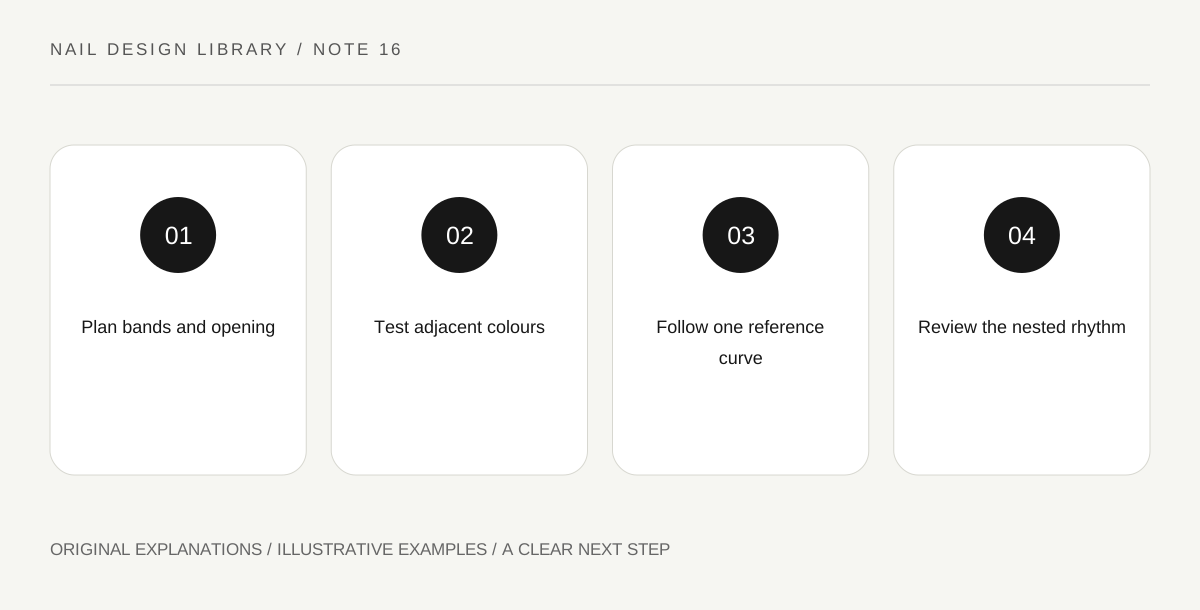
Original explanatory diagram. Read the full method and limitations below.
Plan bands and the central opening
Draw an arch and two or three surrounding bands on an actual-size outline. Compare a wide central opening with a tight one. More bands create more boundaries to control, so choose a small number before attempting a full spectrum. A simplified rainbow shorthand can be complete.
Decide whether the motif sits near a side or in the centre. Cropping part of the arcs at an edge can create another composition, but plan it rather than discover halfway through that the outer band has no room. The available surface sets the practical scale.
A cropped outer arc can make the motif feel larger than the available surface, while a fully enclosed version feels more contained. Sketch both before committing to the painted band count.
Choose colour order through contrast
Adjacent colours should remain distinguishable if separate bands are the goal. Two similar values may blend visually even when their hues differ. Test the dried sequence on a swatch and decide whether you want bright contrast or a quieter related palette.
A rainbow-inspired design does not need to reproduce a scientific spectrum. Describe a personal colour sequence honestly rather than claim every combination is a literal rainbow. The repeated curve provides the motif’s structure while colour supplies another chosen relationship.
Paint from a stable reference curve
Over a compatible base ready for detail work, begin with the arc you can use as a reference. On a practice swatch, this may be the inner or outer line depending on your brush control. Use a suitable nail-art brush and modest conventional lacquer loading.
Follow the reference at a chosen distance rather than invent a new curve for every band. If the space narrows, stop and review before continuing. Thickening the inner arc to repair one side can consume the central opening. A simpler fresh attempt may preserve the design better than repeated local adjustments.
Compare rhythm rather than perfect geometry
Small variations are acceptable when the overall nested relationship is clear. View the design from hand distance and look at the gaps between bands. They often matter more than whether each curve could be measured as a perfect semicircle.
For an exercise, paint a two-band and a three-band version using the same outer size. Compare the central gap and readability. Choose the version you can control comfortably, then apply a compatible finish as directed. More colours or narrower bands do not automatically represent greater success.
Illustrative arc choice
A learner sketches five bands but finds the centre disappears on a short outline. They reduce the motif to three arcs with clear contrast. The first painted band becomes the reference for the next two. A small variation remains on one side, but the nested rhythm reads clearly, so they stop rather than thicken every band to force exact symmetry.
Practical checks
Optional checkboxes save only in this browser.
Questions that come up
Do I need seven colours?
No. A few nested coloured arcs can create a rainbow-like motif. Choose a manageable number and describe it as an interpretation rather than a scientific spectrum if the sequence is personal.
Should every arc have exactly the same thickness?
Consistency can support the rhythm, but tiny differences do not necessarily matter. Preserve readable gaps and the overall shape instead of correcting until the central space disappears.
References and scope
These sources support the factual background. Examples and exercises are original illustrative teaching material. References do not imply endorsement.
- FDA: Nail care products — Cosmetic scope, following labels and warnings, ventilation, ignition risks and reactions.
- Essie: Mastering nail art — Conventional polish tools, controlled dots, stripes, sponge gradients and compatible finishing.
- Getty Museum: Principles of design — Spacing, repetition, emphasis and visual rhythm in original miniature compositions.
- Getty Museum: Elements of art — Line, shape, colour value and negative space.