Paint a cherry-pair motif with clear fruit and stem shapes
A tiny cherry pair uses two round shapes and a connecting stem as a simple visual shorthand. The challenge is keeping the parts distinct at a small scale. Plan the fruit size first, then add a thin stem and optional leaf without turning the motif into a crowded patch.
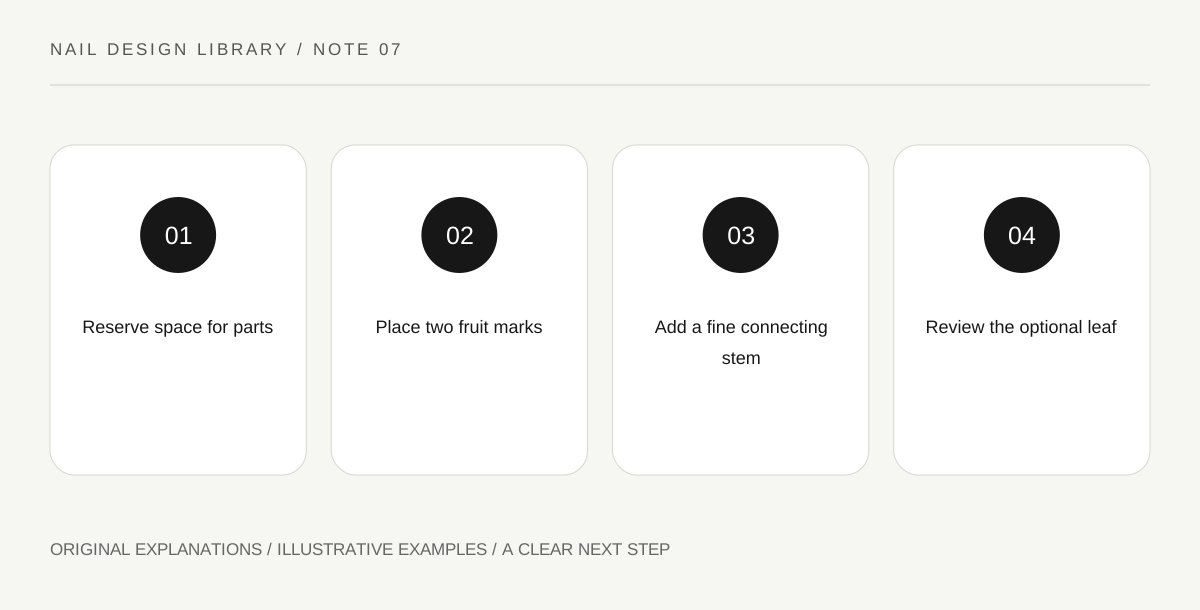
Original explanatory diagram. Read the full method and limitations below.
Decide how much detail the surface can hold
Sketch two circles with a gap between them on a nail outline. Leave room above for the stem. If the circles already fill the width, reduce the motif or use one pair rather than several. A small illustration is easier to read when its essential parts have separate space.
Choose a base that lets the fruit colour remain visible. Red is a familiar choice, but the design can use another colour deliberately. What makes the shorthand recognizable is the relation between round fruit and stem, not a requirement to reproduce a realistic photograph.
Create two controlled fruit marks
Over a ready compatible base on a practice swatch, use a suitable rounded tool to place the circles. They can differ slightly in size and position. A perfectly mirrored pair is optional. Keep the amount of lacquer modest so the shapes do not spread together.
Check from ordinary distance before adding detail. If the fruit marks are indistinguishable from the base, test a more visible colour relationship rather than build thick layers. If they merge, increase the gap or reduce loading on a fresh swatch.
Connect the stem with a planned route
Draw the stem route on paper first: two short lines meet at a higher point. Use a fine nail-art brush for the painted version. The stem should be thinner than the fruit so the visual hierarchy remains clear. A heavy stem can become the main object and obscure the intended motif.
Work in short controlled strokes rather than drag a large drop across the surface. If a line breaks slightly, decide whether it still reads before repairing. The miniature does not need continuous botanical realism. The useful target is a clear connection among the parts.
Add a leaf only if it has room
One small leaf can provide a directional accent, but it is optional. Place it near the stem junction with space around it. Adding several leaves may make the shape read as a plant cluster rather than a cherry pair, which is another design but not the one being practised.
For an exercise, compare the same fruit pair with no leaf, one leaf and several leaves on separate outlines. Keep the rest constant. Choose the clearest version at normal viewing distance, then finish according to the compatible products’ instructions without assuming a universal dry time.
Illustrative fruit-and-stem study
A learner paints two red circles on a pale practice base. The first stem is nearly as thick as the circles, making the motif look like a bow. The next attempt uses a finer brush load and a higher junction. One small leaf is enough. They keep a single pair on the accent area instead of squeezing three motifs into the available space.
Practical checks
Optional checkboxes save only in this browser.
Questions that come up
Do both cherries need to be identical?
No. A slight size or height difference can look natural and remain readable. Focus on distinct round shapes and a clear stem relationship rather than exact symmetry.
Why does the motif look like a bow?
The connecting line may be too heavy or the fruit marks may be too small. Compare the relative widths on a swatch and let the round shapes carry the main visual weight.
References and scope
These sources support the factual background. Examples and exercises are original illustrative teaching material. References do not imply endorsement.
- FDA: Nail care products — Cosmetic scope, following labels and warnings, ventilation, ignition risks and reactions.
- Essie: Mastering nail art — Conventional polish tools, controlled dots, stripes, sponge gradients and compatible finishing.
- Getty Museum: Principles of design — Spacing, repetition, emphasis and visual rhythm in original miniature compositions.
- Getty Museum: Elements of art — Line, shape, colour value and negative space.